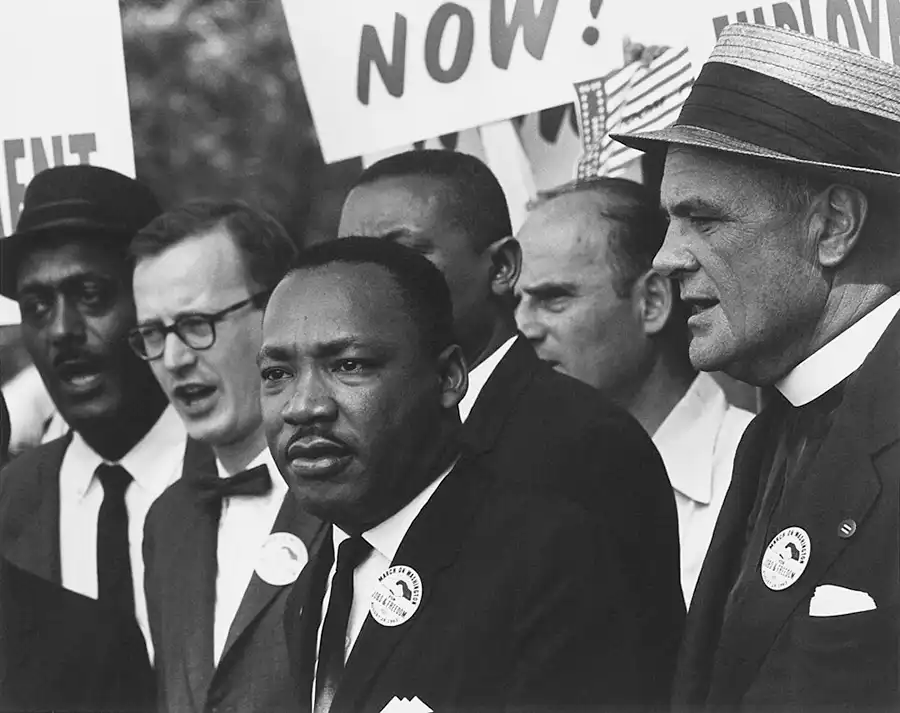
Dr. Martin Luther King Jr., a staunch civil rights leader, championed racial justice and equality in the U.S. during the 1950s and 60s. To realize his dream of a fair society, Dr. King advocated for equal educational opportunities for all. In his 1947 article, “The Purpose of Education,” he said:
“Education must enable a man to become more efficient, to achieve with increasing facility the ligitimate goals of his life.”
Dr. King understood education—particularly literacy—as a powerful tool for personal empowerment and social change. The ability to read, write, and think critically enables individuals to advocate for themselves and participate fully in society. Yet, systemic inequities denied many people of color access to quality education, limiting opportunity and economic mobility.
However, people of color lacked access to education, making it difficult for them to achieve this growth. As a result, Dr. King spoke out against educational inequality, addressing the negative effects of segregation in schools and the limited resources available to Black students. He encouraged students to use their voice alongside him, organizing student sit-ins, peaceful protests, and marches for their cause.
In 1957, Dr. King founded the Southern Christian Leadership Conference (SCLC), an organization dedicated to improving and educating marginalized communities on various issues, like literacy and voting rights.
Dr. King also understood the link between education and economic opportunity. The more educated someone is, the more likely they are to find a higher-paying job to become financially stable. This leads to a stronger society and generational change. Alongside education, Dr. King would help people of color obtain postsecondary education or the experience they need to achieve higher-income careers.
His legacy would improve the lives of millions and leave a lasting impact. Yet, there is still work to be done.
Today, systemic barriers—including racial inequity, economic hardship, health challenges, and caregiving responsibilities—continue to limit educational access for adults. As a result, many are forced to leave school early, leading to long-term underemployment or unemployment. According to the U.S. Census, 9% of adults nationwide and 7% of adults in Washington, DC lack a high school diploma, disproportionately impacting Black communities. In DC, one in five adults lacks basic literacy skills, affecting both daily life and career advancement.
At Academy of Hope (AoH), we address these challenges by offering free high school diploma programs and workforce certifications to adult learners. Like Dr. King, we believe education and advocacy go hand in hand. For over 40 years, AoH has championed policies that strengthen adult education systems at both the local and federal levels.
Throughout our 40 years of service, AoH has committed itself to prioritizing policies that reimagine systems and funding adult education by taking a stand in our local and federal governments. Funding cuts on K-12 and adult education continue to impact programs across the country. While AoH is locally funded, other programs rely on federal money, making it difficult to serve their learners to their full potential.
Decreasing or eliminating federal assistance programs that learners are reliant on have harmed communities, as well, negatively impacting daily well-being and long-term goals towards economic growth. For instance, the federal blocking of the Supplemental Nutritional Assistance Program (SNAP) funds in November affected those eligible to receive nutritious foods for their families. AoH’s Student Support Team sprang into action to provide information and emergency assistance in an attempt to make up for the lost funds.
Since many AoH learners face these challenges firsthand, we encourage them to use their voices alongside us to empower themselves and others. For instance, in September, AoH learners visited the capitol for the Coalition on Basic Adult Education’s Flood the Hill event. There, they connected with other learners and shared their emotional stories with Congress, highlighting the need for funding the lives that could be changed like theirs.
On the local level, learners and staff testified before the Council of the District of Columbia Committee of the Whole. In the November hearing, AoH, alongside other D.C. adult education schools requested the continued support from the committee and additional resources that could better aid learners’ academic and career development.
Now it’s your turn to take action. Inform others about the importance of adult education. Bring public statements to officials. Get involved by volunteering or donating to AoH. We must unite to include adult education in the conversation on racial justice and equity to bring Dr. King’s vision to fruition.